Why there are several token types
Start with the task: replacing a module, restoring an available feature or running diagnostics. These tasks require different data. Check which request the program creates before choosing a service.
Comparison table
| Type | Purpose | Required input |
|---|---|---|
| KDS | Component theft protection | Original KDS request |
| SFA | Activation of available features | VIN or feature request, depending on the service |
| LCS | ECU configuration switches | ECU data and intended configuration |
| SecOC | Secure communication between ECUs | Data for the relevant operation |
| ISTA Diagnostic Token | Diagnostic-operation authorization | ISTA request |
KDS token workflow
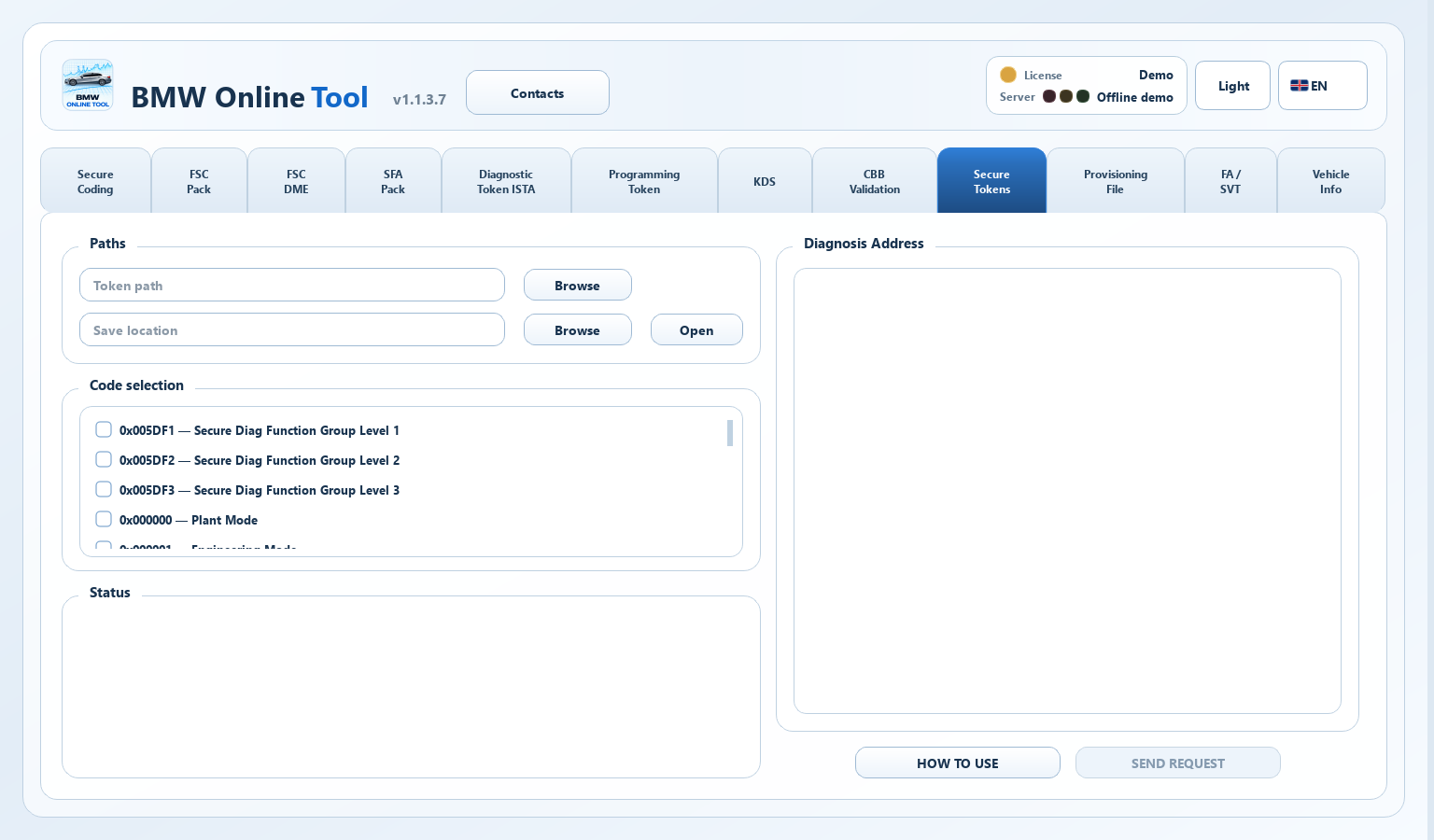
KDS protects components against theft and binds a module to the vehicle. The token service requires an original KDS request. Return the response to the operation that exported it.
SFA feature activation
SFA controls feature activation. A package requested by VIN and a request for a specific ECU feature are different tasks. The website package service uses VIN17; it does not sell arbitrary new vehicle options.
LCS and SecOC
LCS means Locking Configuration Switch: a control-unit configuration switch, not lifecycle. SecOC concerns secure message exchange between control units. They describe different functions.
ISTA diagnostic token
An ISTA diagnostic token responds to an operation requesting authorization. It is not an ISTA license. Keep the original request and use its response for that operation.
Safe handling checklist
- Check the vehicle and required service before submitting.
- Keep the original file contents unchanged.
- Store each request with its response; do not mix attempts.
- If application fails, record the stage and error message.
ONLINETOOL SERVICES
Use the related online service
A clear comparison of BMW KDS, SFA, LCS, SecOC and ISTA diagnostic token workflows, their inputs, outputs and typical use cases.
Frequently asked questions
Can a KDS token be used as an SFA package?
No. They belong to different protected workflows and are not interchangeable.
Are all SFA requests VIN-only?
No. Some are vehicle/package requests, while others include feature, ECU UID and diagnostic-address context.
Is LCS the same as SecOC?
No. They can interact in vehicle security/configuration workflows, but they describe different functions.
Can I reuse a diagnostic token after restarting ISTA?
A new session may produce a new request. Use the response that matches the active request and session.
Which BMW service fits your request?
Choose by the input requested by your local tool. These services return different results and do not replace one another.
NCD 2.0 / 3.0
Input: Matching FA and SVT XML.
Result: Signed NCD files for supported ECUs.
KDS
Input: Original KDS JSON request.
Result: Token package for the original workflow.
SFA
Input: Full VIN17 for online orders; VIN7 only in specific desktop tools.
Result: Package of supported factory functions.
ISTA
Input: ISTA request file and required mode.
Result: Diagnostic token response.
CBB Validation
Input: Original CBB request.
Result: Validation response for the original workflow.
BMW FSC vs SFA: Activation Codes and Packages Explained
BMW FSC Pack and SFA explained: restoring activations, purchasing options, preparing vehicle data and why NCD coding does not replace an activation package.
Source
E-Sys 25.10.01 manual: SFA / LCS and KDS sections. This document explains the technologies; service availability and scope must be checked separately.